
The Buffett Economics e-book
Value investing, from zero to hero.
The method Warren Buffett describes in fifty years of shareholder letters, taught from the ground up: how to read a business, put a sensible value on it, and have the patience to wait for the right price.
Launch sale ends November 30, 2026, 11:59 PM EST. Time left:
The launch sale ended November 30, 2026, 11:59 PM EST.
Get the book for $29$57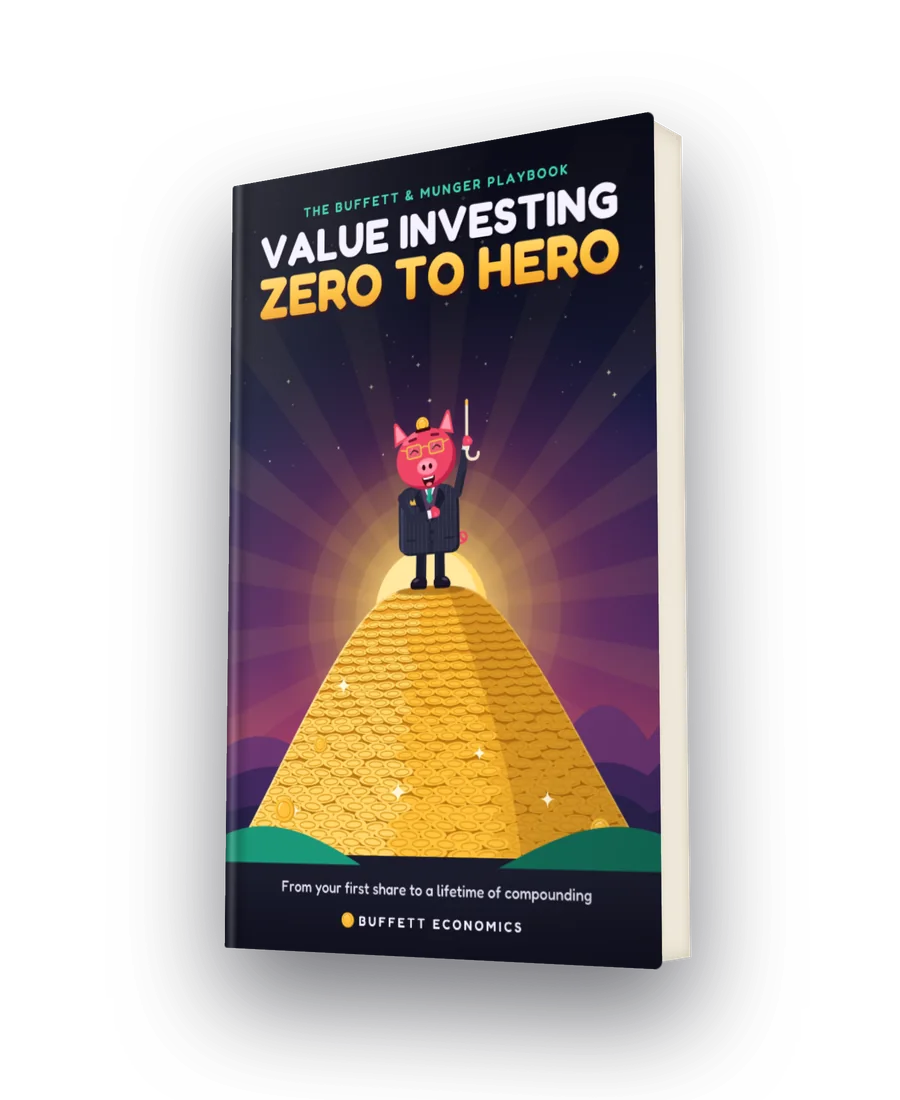
What you will be able to do
Think like an owner, not a ticker-watcher
Read a business
Turn an annual report into a short list of questions that matter: how the company makes money and what could stop it.
Put a value on it
Owner earnings, discounting and a margin of safety, worked through step by step with clearly labelled example numbers.
Spot a moat
Brands, switching costs, network effects and low-cost advantages, and how to tell a durable one from a temporary lead.
Use Mr. Market
Why price swings are a gift to a patient buyer, and a simple plan for what to do when everyone else is panicking.
Stay in your circle
How to choose what you understand, ignore what you don't, and why saying no is most of the job.
Let time compound
Costs, taxes and behaviour: the quiet things that decide how much of the return you actually keep.
Read it anywhere
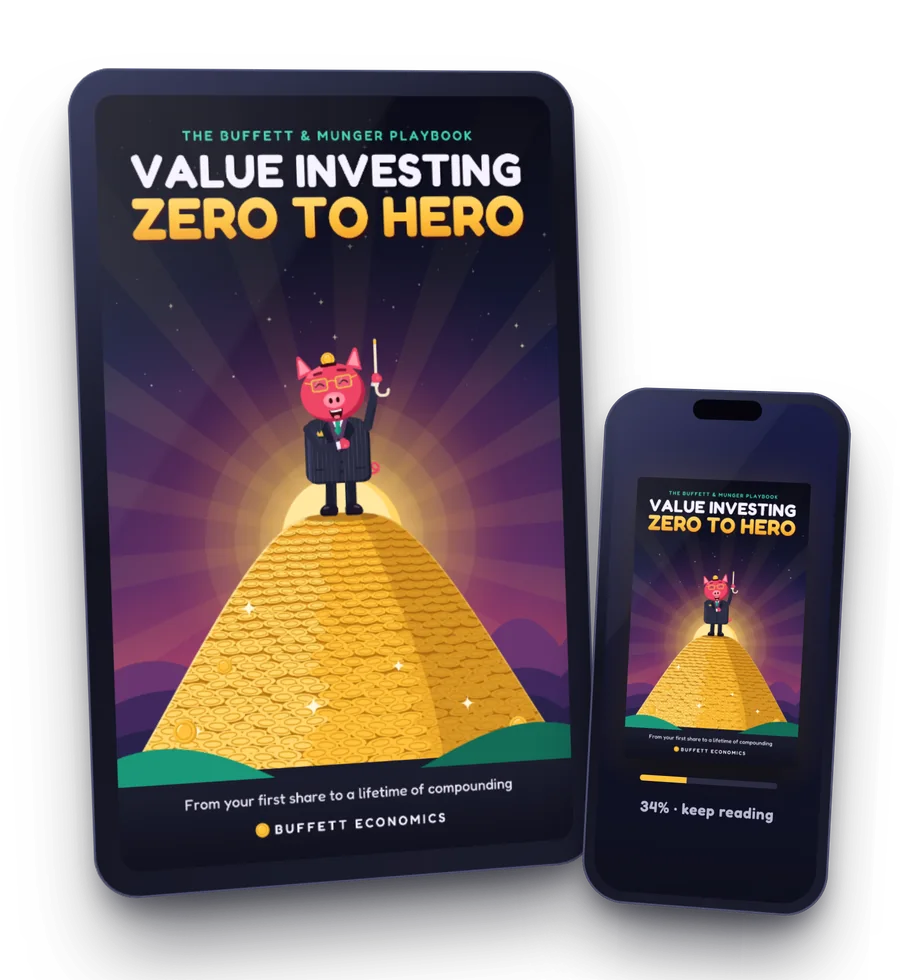
A PDF that reads well on every screen
Laptop, tablet, phone or e-reader. No app and no account needed. Download it once and it's yours.
- Instant download link by email after checkout
- Print-friendly PDF; an EPUB for Kindle and Apple Books follows, free for buyers
- Re-download any time from your account
Inside the book
Chapter by chapter
634 pages, 36 illustrated chapters and 150+ charts and diagrams, in the same flat style as the videos. Every number shown as fact is sourced (see every source); worked examples are labelled as examples.

- Part One · The Owner's Mindset
A Stock Is a Piece of a Business
What a share actually entitles you to, where an owner's money comes from, and how a dying textile mill became Berkshire Hathaway.
Price and Value: Two Different Numbers
Why the price on your screen and the value of the business drift apart, shown through Coca-Cola's sixteen flat years after 1998.
Meet Mr. Market
Graham's moody business partner, why volatility differs from risk, and what Berkshire's own four big price falls taught its owners.
Compounding: The Snowball and the Long Hill
Doubling times in your head, why time beats rate, and how fees, trading and taxes drain a compounding pile.
Inflation, Interest Rates and the Gravity on Every Price
Why rising rates pull down every price, how inflation quietly taxes owners, and what the 1977 to 1982 market showed.
Investing or Speculating? Know Which Game You're In
Buffett's three kinds of investment, the gold cube that produces nothing, the record of frequent traders, and Bitcoin as a test.
- Part Two · Reading a Business Like an Owner
The Income Statement Without Tears
Read an income statement top to bottom in five minutes, with thirty-five years of See's Candies as the worked example.
The Balance Sheet: What It Owns, What It Owes
What a company owns, what it owes, and how Lehman Brothers went from record profits to bankruptcy in ten months.
Cash Is a Fact: Cash Flow and Owner Earnings
Buffett's 1986 owner earnings recipe, why depreciation is a real cost, and what telecom's 2000 build-out says about AI spending.
Return on Capital: How Much Each Dollar Earns
How to measure what each tied-up dollar earns, and why a small candy company made Berkshire far more than an airline.
Debt: The Friend Who Turns on You
The plain arithmetic of borrowing, how a margin call takes the decision away, and why Long-Term Capital needed rescuing in 1998.
When the Numbers Lie: Accounting Red Flags
The few tricks behind most accounting blow-ups, how Enron used them, and a checklist you can run on any annual report.
- Part Three · Moats and the People in Charge
What a Moat Is, and How Long It Lasts
Where moats come from, how fast they erode, and why Kodak and Coca-Cola, both famous brands in 1996, ended so differently.
Pricing Power: The See's Candies Lesson
How See's Candies raised prices year after year and kept its customers, and how to check any company for real pricing power.
Brands That Live in Your Head: Coca-Cola, 1988
Why Buffett paid up for Coca-Cola in 1988 and meant to hold it forever, and what happened once the market overpaid.
The Low-Cost Moat: GEICO
How GEICO turned direct selling and float into a decades-long cost advantage, nearly died in the 1970s, and later lost ground.
Switching Costs and Networks: Apple and the Platforms
Switching costs and network effects in the numbers, with Berkshire's Apple stake followed from the first share to the big sale.
Managers, Capital Allocation and Integrity
Five things a manager can do with spare cash, the allocators Kay Graham and Tom Murphy, and Buffett's 1991 Salomon rescue.
- Part Four · What Is It Worth?
Intrinsic Value: The Cash You Can Take Out
Buffett's one-sentence definition of value, discounting in plain words, and why Berkshire stopped leaning on book value in 2018.
Valuing a Business With Pencil and Paper
Four steps and one sheet of paper give an honest range of values, tested on Coca-Cola as it looked in 1988.
Margin of Safety
Measure room for error from the cautious end of your range, and see why Buffett's Washington Post bargain fell further.
Price Tags Compared: P/E, Earnings Yield and the Buffett Indicator
P/E, earnings yield, the ten-year CAPE and the Buffett indicator, plus the cases where a cheap-looking number is really expensive.
Growth and Value Are Joined at the Hip
One test for whether growth makes owners richer, shown through JetBlue and Amazon, two growth stories that started the same Friday.
Cheap for a Reason: Cigar Butts, Value Traps and the Textile Mill
How bargain-bin investing works, how to spot a value trap before it springs, and the textile mill that cost Buffett twenty years.
- Part Five · Manias, Crashes and What Survived Them
1973–74: The Nifty Fifty and the Washington Post
How America's favourite companies reached 40 to 95 times earnings, what 1973 to 1974 did to them, and Buffett's Washington Post purchase.
Black Monday, 1987
How portfolio insurance turned a bad week into the day stocks lost a fifth of their value, and what Buffett did next.
The Dotcom Bubble, 1995–2002
How to recognise a mania from inside it, why Cisco was the right business at the wrong price, and Berkshire's worst year.
The 2008 Financial Crisis: Leverage Comes Due
Risky mortgages to failing banks in plain words, and the terms Buffett set on his Goldman Sachs and General Electric deals.
March 2020: The Fastest Crash
Thirty-three days down and five months back, and why Berkshire sold its airline shares in 2020 and mostly sat on its cash.
Free Money: Meme Stocks, SPACs and the 2022 Rate Shock
How near-zero rates inflated far-future profits, three weeks of GameStop, blank-cheque companies, and the 2022 rate shock that ended it.
The AI Boom, 2023–2026
Every Buffett test in the book applied to the AI boom, from supply chains and data-centre bills to the price paid.
- Part Six · Building Your Own Way
The Index Fund Option: Buffett's Million-Dollar Bet
Buffett's ten-year bet against a group of hedge funds, what fees really take, and when owning the whole market makes sense.
Circle of Competence and Concentration
How to draw an honest line around what you understand, and how Berkshire sized its bets on Apple and Japan's trading houses.
Mistakes Worth Studying
Sixty years of Buffett's own confessions, including how paying in shares turned a $433 million Dexter Shoe error into $20 billion.
Temperament: Patience, Taxes and Doing Nothing
Why Berkshire's best results came from holding still, how taxes reward patience, and how checklists and Munger's inversion help.
Your Investing Rulebook
Turn the whole book into one handwritten page covering what you own, when you buy and sell, and your crash plan.
Placeholder: the chapter list appears here automatically from funnel/book/outline.md
Chapter title
One-line summary of the chapter.
Chapter title
One-line summary of the chapter.
Chapter title
One-line summary of the chapter.
Chapter title
One-line summary of the chapter.
Chapter title
One-line summary of the chapter.
Chapter title
One-line summary of the chapter.
Not sure yet?
Read a full chapter free
We'll email you chapter 31, "The AI Boom, 2023–2026", so you can see the style and the depth before you buy. You'll also get The Daily Moat, free; unsubscribe any time.
Readers
What readers say
The book is new, so these slots are empty on purpose. We only publish real, attributed reviews.
guarantee
Read it. If it doesn't help, get your money back.
If the book isn't for you, email hello@buffetteconomics.com within 30 days of purchase and we'll refund you in full. No forms, no questions. Details in our refund policy.
Questions
Frequently asked
What format is the book?
You get a 634-page PDF (36 illustrated chapters, 150+ charts and diagrams) that reads well on a laptop, tablet or phone, with no app or account needed. An EPUB edition for Kindle and Apple Books follows and is free for everyone who bought the book.
How do I get it after paying?
Right after checkout we email you a secure download link. It works several times over a few days, and you can request a fresh one any time from the subscriber sign-in page.
Do I need any investing experience?
No. The book starts from zero: what a share is, how a business earns money, and how to read the few numbers that matter. Experienced investors tend to enjoy the valuation and moat chapters most.
Where do the numbers and quotes come from?
Every number, date and quote is listed with its source, chapter by chapter, on the sources page: Berkshire shareholder letters, company filings and official data.
Is this investment advice?
No. The book is educational. It explains a way of thinking about businesses and prices; it does not tell you what to buy or sell. Please read our disclaimer.
Is it endorsed by Warren Buffett or Berkshire Hathaway?
No. Buffett Economics is an independent educational project and is not affiliated with Warren Buffett or Berkshire Hathaway. His words appear only as verbatim quotes with their source.
What about The Daily Moat?
The daily letter is free for everyone. Tick the box at checkout and we'll add you to it when you buy, or subscribe here.
Which payment methods can I use?
Checkout is handled by Dodo Payments, our merchant of record. Major cards are accepted, plus local methods where available in your country. Prices are in US dollars; local taxes may apply and are shown before you pay.
When does the sale price end?
The launch sale ends November 30, 2026, 11:59 PM EST, the same moment for everyone, as shown in the countdown. After that the book is $57.

Start with the book. Keep it for life.
One payment, no subscription, yours to keep.